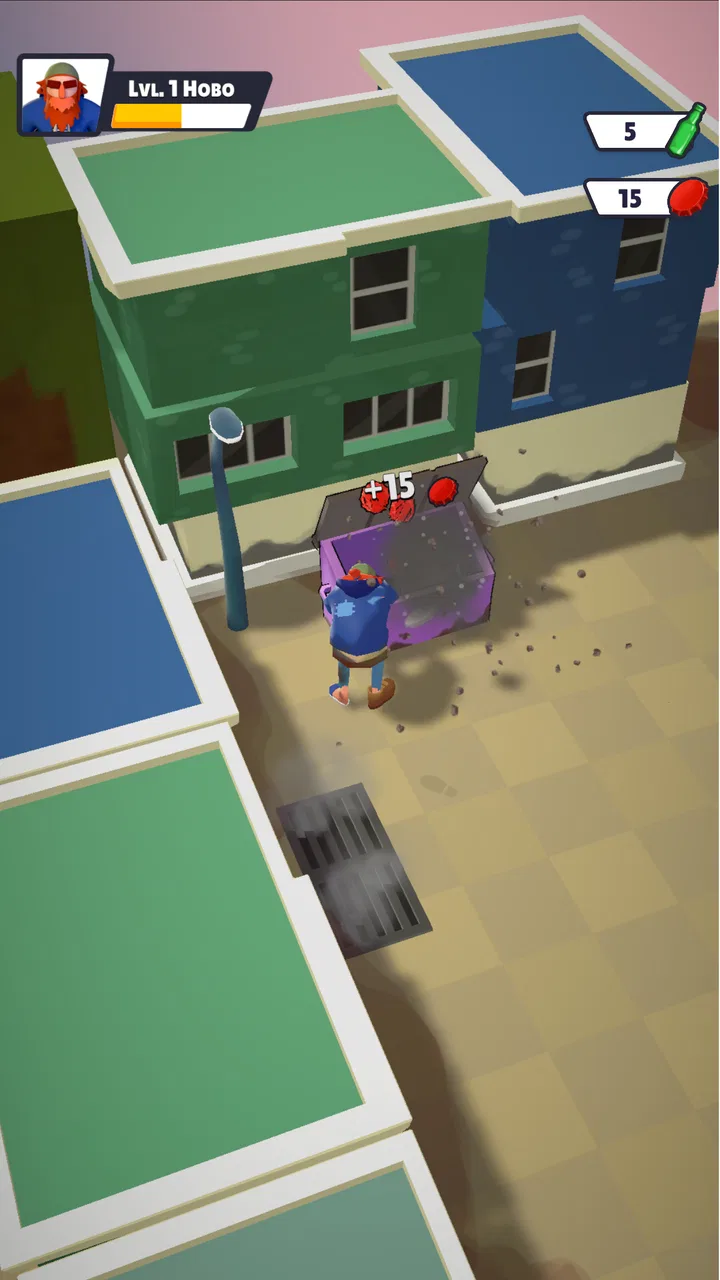
Street Dude - Homeless Empire
- 4.6
- Rating
- 5.00M
- Installs
- Free
- Price

 Analysis by App-foxy
I went into Street Dude - Homeless Empire expecting a quick mobile adventure and found a game built around a simple, immediately understandable idea: start with almost nothing, make small gains, and work toward becoming a successful street character. That basic loop is easy to grasp in a few minutes, which makes it a comfortable choice when I want something casual rather than a demanding role-playing game.
What makes it worth discussing is not complexity, but how well it turns a rough starting point into a steady sense of progress. The game is free to download, belongs to the adventure category, and is made by SayGames Ltd. It has attracted over five million installs and holds a 4.6 average from around one hundred two thousand ratings, so it is clearly reaching a large audience. My experience was generally positive, although the simplicity that makes it approachable also limits how deep the long-term challenge feels.
How the current version feels to play
The current release is version 1.3.2, and it presents itself as a compact, accessible mobile game rather than a full-scale adventure epic. The age guidance is Everyone 10+, and that fits the tone: the premise uses homelessness as a playful starting point, but the presentation is designed for light entertainment instead of a serious simulation. I would describe it as an arcade-style progression game with adventure elements, not as a realistic story about life on the street.
You May Also Like

 Blood Strike: 2.5 Anniversary
Blood Strike’s Loadouts Turn Every Drop Into a Tactical Gamble
A close look at Blood Strike’s custom loadouts: how fast access to signature weapons reshapes its battle royale rhythm, rewards preparation, and narrows the gap between fights.

 Pandora - Music & Podcasts
Pandora’s Music Is Easy to Start, but Harder to Recover
Pandora’s strength is its low-effort path from a seed to a station. Its weak spot is how much confidence it asks you to place in connection, setup, and quiet recovery.

 8 Ball Pool
 Is Built on Rivalries, Rematches, and Routine
A close look at the rivalries, rematches, shared routines, and unanswered safety questions that turn a quick pool match into a persistent mobile community.

 Samsung Music
’s Quiet Strength Is Playing What You Already Own
Its reach comes less from spectacle than from dependable access to a personal library. That simplicity is both the app’s strongest retention engine and its ceiling.

 AccuWeather: Weather Radar
AccuWeather Review: A Quick, Clear Forecast for Everyday Decisions
For everyday plans, the best forecast is the one you can understand quickly. AccuWeather makes rain timing, radar, and local conditions easy to act on, with a few trade-offs.

 Hill Climb Racing
Why Hill Climb Racing Still Turns Crashes Into One More Run
A tiny car, a bumpy hill and one more upgrade: Hill Climb Racing keeps resurfacing because its simple chaos makes every near-miss feel personal.
More From Our News Desk



The first useful thing to understand is the rhythm. You begin with very limited resources, look for ways to improve your position, and gradually move toward a more comfortable and successful existence. The satisfaction comes from seeing modest actions lead to visible advancement. I often found myself opening it for a short break, completing a few tasks, and stopping once I had reached a small target.
That makes it especially suitable for players who enjoy incremental progress but do not want to study a complicated control system. The game communicates its immediate goals clearly, and its cartoon-like framing keeps the mood light. I never felt that I needed a long tutorial session before understanding what I was supposed to do.
At the same time, anyone looking for a rich adventure with layered dialogue, exploration that rewards careful observation, or a deep character-building system may feel under-served. The appeal is in the quick loop, not in a large world full of surprises. This is best treated as a casual progression game with an adventure skin, and that expectation makes a big difference to how enjoyable it is.
The opening hours reward small decisions
During the early part of a session, I found the most enjoyable moments came from choosing what to improve first. Even when the available actions are straightforward, deciding whether to pursue immediate progress or prepare for a later gain gives the game a little more texture than a simple tap-and-wait experience.
My practical advice is to avoid spending every resource as soon as it appears. Keeping a small reserve gives you more flexibility when a new objective arrives, and it prevents the session from becoming a sequence of rushed purchases. This is one of those small habits that matters more than it initially seems, particularly when progress starts to require better planning.
I also recommend playing in short, deliberate sessions instead of leaving the game open without a purpose. The basic loop is more satisfying when I decide what I want to accomplish before starting. For example, I might begin while waiting for a coffee, focus on one improvement, and close the game once that goal is complete. That approach keeps the progression feeling earned rather than repetitive.
Where the adventure framing works
The adventure label makes sense because the game gives the player a journey from a difficult beginning toward a more prosperous outcome. There is a clear feeling of movement, and the changing circumstances provide motivation to continue. I liked that the game does not require me to commit to a long uninterrupted play session to feel progress.
However, it is important not to confuse a progression journey with a narrative adventure. If your favorite games are built around memorable characters, emotional storytelling, puzzles, or detailed exploration, this will probably feel too mechanical. Its story is mainly expressed through the change in the player’s situation, not through a complex plot.
Compared with a traditional adventure game, it asks less of the player. There is less need to remember a large cast or solve elaborate problems, but there is also less room for interpretation. Compared with a standard idle or management game, its street-themed setting gives the progression a more distinctive personality, even though the underlying appeal remains focused on gradual improvement.
What has changed and what that means for players
The release date was September 15, 2022, and the current version shows that the game has continued to exist as an active product rather than remaining frozen at its launch state. That is useful context for anyone discovering it now: you are not looking at an abandoned experiment, but at a game with a maintained version number and an established player base.
I would still be careful about reading too much into the version number alone. A newer release does not automatically mean that the game has become deeper or that every early frustration has disappeared. From a player’s perspective, the important question is whether the current build feels stable, understandable, and enjoyable for the intended audience. In those areas, it does a good job of offering a smooth entry point.
For existing users, the current state is most likely to matter in practical ways. A player returning after a break should approach it as a familiar casual game, not expect a completely transformed experience. The core attraction remains the same: begin from a low point, make progress through repeated actions, and enjoy the visual and numerical signs of improvement.
That continuity is both a strength and a weakness. It means returning players do not have to relearn an entirely different game, but it also means someone who stopped because the loop felt repetitive may not find a fundamentally new reason to come back. The version evolution appears more relevant to refinement and continued availability than to a total redesign of the concept.
How I would approach spending
The game is free, which makes trying it straightforward, but it includes in-app purchases ranging from $0.99 to $49.99 per item. I did not feel that I needed to pay simply to understand the game or enjoy its opening progression. That is important because the early experience works well as a no-cost trial of the concept.
My recommendation is to play long enough to decide whether the central loop genuinely suits you before considering any purchase. If you already know that repeated progression games are your thing, optional spending may feel convenient. If you are undecided, paying early can make it harder to judge whether you enjoy the game itself or merely enjoy moving through it faster.
A useful personal rule is to treat purchases as a convenience rather than a requirement. I would not buy anything to solve impatience during the first few sessions. Instead, I would identify whether the game still feels engaging when progress is earned at its ordinary pace. That test tells you much more about its lasting value than a fast start does.
This is also where the game differs from a premium adventure title. A paid game usually asks for money before play and then offers a more predictable structure. Street Dude uses the opposite approach: the download is free, but optional purchases can become part of the experience for players who want them. Neither model is automatically better, but players who dislike in-app purchase pressure should be especially deliberate.
Who will enjoy it most
I would recommend it to someone who likes compact mobile games with visible progress, uncomplicated controls, and a playful rise-from-nothing premise. It works well for short breaks, commutes, or those moments when I want a game that starts quickly and does not demand complete concentration.
It is also a reasonable choice for a younger audience within the Everyone 10+ guidance, provided the person playing understands that the theme is exaggerated and game-like rather than an accurate portrayal of homelessness. The bright, simplified presentation makes the subject less heavy, but that same treatment may not appeal to players who prefer sensitive or realistic storytelling.
I would skip it if you want competitive multiplayer, a long cinematic campaign, or a demanding strategy system where every decision can reshape the entire game. I would also look elsewhere if you dislike progression loops that depend on repeating familiar actions. In that case, a premium adventure with stronger narrative focus would probably offer better value, even if it has a higher entry cost.
Small strategies that make the loop better
One of the less obvious ways to improve the experience is to separate “progress” from “activity.” Not every available action needs to be completed immediately. I found the game more manageable when I chose a single short-term objective and ignored distractions until it was finished. That prevents the session from turning into unfocused tapping.
Another useful habit is to check the cost of the next meaningful improvement before committing current resources. This creates a simple planning buffer and makes the climb feel more intentional. It is not advanced strategy, but it changes the mood from reacting to prompts to making choices.
I also found that the game works better when I use it as a break-time activity rather than a primary game. Its quick accessibility is a genuine strength, but extended sessions can expose the limits of the content and make repeated actions feel more obvious. Short play keeps the central fantasy fresh for longer.
Finally, I would judge progress by personal milestones instead of trying to rush toward the richest possible outcome. The premise encourages ambition, but the enjoyment comes from the sequence of improvements. Chasing the endpoint too aggressively can make the middle of the journey feel like an obstacle instead of the main attraction.
Remaining gaps and realistic trade-offs
The biggest limitation is depth. The game has a clear identity, but its systems do not feel designed for players who want endless experimentation. Once the novelty of the premise fades, the repeated structure becomes easier to predict. That is not a flaw for a short-session game, but it does reduce its appeal as an all-day adventure.
The theme itself is another trade-off. Turning homelessness into a humorous route to wealth gives the game an immediate hook, yet some players may find the treatment too shallow. I could enjoy it as a fictional, exaggerated setup, but I would not recommend it to someone seeking a thoughtful examination of poverty or social hardship.
The free-to-play format can also create friction for people who prefer a single, clearly defined purchase. Even when optional spending is not necessary at the beginning, the presence of items priced up to $49.99 means users should keep their expectations and budget clear. Parents may want to discuss purchases before allowing younger players to use the game.
There is also a gap between its store identity and the expectations attached to the word “empire.” The idea suggests broad management and meaningful control over a large operation, while the actual appeal is more personal and incremental. I enjoyed the climb, but players expecting a detailed tycoon simulator should investigate the early gameplay carefully before committing time.
What to watch as you continue
For new players, I would watch how quickly the game’s repeated actions begin to feel routine. If the small improvements continue to feel rewarding, the game is doing exactly what it is meant to do. If you are already waiting impatiently for the next upgrade after only a few sessions, that is a sign that its long-term loop may not suit you.
Returning players should pay attention to whether the current version improves their reason to come back, rather than assuming that a version update alone changes the experience. The most meaningful test is practical: does the game offer a satisfying short session when you open it today? If yes, its compact design remains effective. If not, the basic formula may be the limitation rather than a temporary issue.
I would also keep an eye on how optional purchases affect your personal enjoyment. Some people are happy to pay for convenience after they have confirmed that they like the game. Others find that the possibility of spending changes the entire atmosphere. Knowing which type of player you are will help you decide whether the free entry is enough or whether another adventure game would be a better fit.
After playing it, I see Street Dude as a friendly, uncomplicated choice for mobile players who enjoy watching a modest beginning turn into visible success. Its strongest qualities are accessibility, a clear progression fantasy, and the ability to fit neatly into spare minutes. Its weakest points are limited depth, a potentially repetitive loop, and a theme that treats a serious real-world subject in a deliberately playful way.
My final recommendation is therefore conditional but positive. Try it if you want a free casual adventure and enjoy gradual upgrades without a steep learning curve. Play patiently, set your own short goals, and avoid spending until you know the ordinary pace works for you. If you want rich storytelling, complex management, or a one-time purchase with no optional extras, choose a different kind of game. For everyone else, Street Dude - Homeless Empire offers a simple climb that can be surprisingly satisfying when played in the short, focused bursts it suits best.
FAQs for Street Dude - Homeless Empire
01What is Street Dude - Homeless Empire about?
Street Dude - Homeless Empire is a casual management and progression game built around the life of a street character trying to improve his situation. You collect resources, complete tasks, interact with different areas, and gradually unlock upgrades, equipment, and opportunities. Its humorous presentation makes the subject matter feel lighter, while the gameplay focuses on short activities, simple decisions, and steady progress rather than complex controls.
02Is Street Dude - Homeless Empire free to download and play?
The game can generally be downloaded and played for free, but it may include optional in-app purchases. These purchases can provide currency, boosts, cosmetic items, or other conveniences that speed up progression. You can experience the main gameplay without paying, although free players may need more patience when waiting for rewards or completing certain upgrades. Check the store listing for the current pricing and purchase details.
03Does the game require an internet connection?
Some features may work without a constant connection, especially basic gameplay that has already loaded on your device. However, an internet connection is commonly needed for advertisements, cloud-related functions, event content, purchases, updates, and synchronization. Availability can vary depending on the version and platform. If you plan to play while traveling, open the game online first and confirm which features remain accessible offline.
04Is Street Dude - Homeless Empire suitable for children?
Although the game uses cartoon-style graphics and straightforward mechanics, its theme involves homelessness, survival, money, and street life, which may not be appropriate for every child. Advertisements and optional purchases may also be present. Parents should review the age rating, privacy information, and store description before installation. Younger players may benefit from supervision, particularly when the device has payment methods connected.
05What should I know about gameplay, ads, and progression before downloading?
Street Dude - Homeless Empire is designed around gradual progression, so completing activities and upgrading your character or surroundings is a major part of the experience. The early stages are usually easy to understand, but progress can become slower as requirements increase. Depending on your device and version, advertisements may appear between activities or offer optional rewards. Players who dislike repetitive tasks, waiting, or monetization prompts should consider this before downloading.
Pros
- Simple controls make the game easy to pick up and play.
- Short missions suit quick gaming sessions on mobile.
- The humorous style keeps the otherwise grim theme lighthearted.
- Progression gives you reasons to keep upgrading your character.
- Runs smoothly on many mid-range Android and iOS devices.
Cons
- Gameplay can become repetitive after completing similar street tasks.
- Frequent ads may interrupt play
- especially between activities.
- Some upgrades take considerable time without optional purchases.
- The humor may not appeal to players seeking a serious simulation.
- Limited customization reduces variety once the main areas are explored.

Street Dude - Homeless Empire
Gallery